


Do Ré Mi Fa Soil: Champagne in the Key of G... An Afternoon with H. Goutorbe in Aÿ


Some Champagne visits are about the wines. Others leave you with a much richer sense of the place and the people behind them.
My visit to Champagne H. Goutorbe in Aÿ was certainly the latter.
At the heart of the Champagne vineyards and part of the UNESCO World Heritage landscape, Aÿ is an ancient, fortified village nestled into the famous hillsides above the Marne. Its slopes have been planted with vines for centuries, shaped by generations of Champagne viticulture and winemaking.
But Aÿ was famous for its wines long before anyone was making Champagne as we know it today. The vin d’Aÿ was already highly regarded throughout the region, with innumerable kings and popes said to have expressed a preference for its wines. Its reputation was built on the vineyards themselves: steep slopes rising above the Marne, with the finest parcels sheltered from the wind and exposed to abundant sunlight.

This is Pinot Noir country, and the grape has long been central to Aÿ’s identity. At its best, Aÿ Pinot Noir is known for a distinctive combination of aromatic purity, richness and a velvety structure, a character shaped as much by the landscape as by the grape itself.
I spent an afternoon with fourth generation grower, Étienne Goutorbe, moving between the cellars, the vineyards and the history of this family house. He shared not only the story of Goutorbe, but his own perspective on the vineyards of Aÿ and the choices that shape the wines.
What struck me immediately was how personal the visit felt. There was time to move beyond the tasting and the technical details, to understand the people, the history and the thinking behind the bottles. It was the kind of experience that changes the way you approach the wine afterwards. The kind of visit that stays with you.
The Goutorbe family has been producing estate-bottled Champagne in Aÿ since the late 1940s, but their connection to the vine began well before the first bottles carried the family name.

Just after the First World War, Émile Goutorbe established himself as a pépiniériste, propagating vine cuttings while working as vineyard manager for Perrier-Jouët. His nursery business flourished, and that expertise would become the foundation of the family’s future in Champagne. Its success eventually allowed him to acquire parcels of vines in and around Aÿ.
His son Henri continued the nursery business while creating the Goutorbe label, bottling and selling Champagne from the family’s own vineyards. In the late 1940s, the family began producing estate-bottled Champagne, establishing a tradition that would continue through four generations.
In 1970, Henri’s son René and his wife Nicole took the estate into a new chapter, expanding the vineyard holdings and enlarging and modernizing the winery. Over the following decades, René also shaped the wines and cuvées that would establish the Goutorbe name.
The next generation gradually joined the family business. René’s daughter Elisabeth came on board in 2001 and later created the Egrot et Filles label with her husband. Her brother Étienne joined the estate in 2007, followed by Bertrand in 2014, continuing the family’s four-generation connection to the vine.

Today, the family owns around 25 hectares of vineyards, a considerable holding for a Champagne grower. The vines are planted predominantly to Pinot Noir, around 70%, with 27% Chardonnay and 3% Meunier.
The jewel of the estate is its six hectares of Aÿ Grand Cru, although the family also owns vines in several neighboring villages, including Mareuil-sur-Aÿ, Bisseuil, Avenay-Val-d’Or and Hautvillers.
That concentration in Aÿ is particularly significant. Here, Pinot Noir has long been at the heart of the village’s identity, its hillsides offering the combination of exposure and terroir that has made the Grand Cru famous.
The family has also embraced HVE (Haute Valeur Environnementale) certification and works to preserve biodiversity across the vineyard, recognizing that the health of the land is inseparable from the quality of the wines it produces.
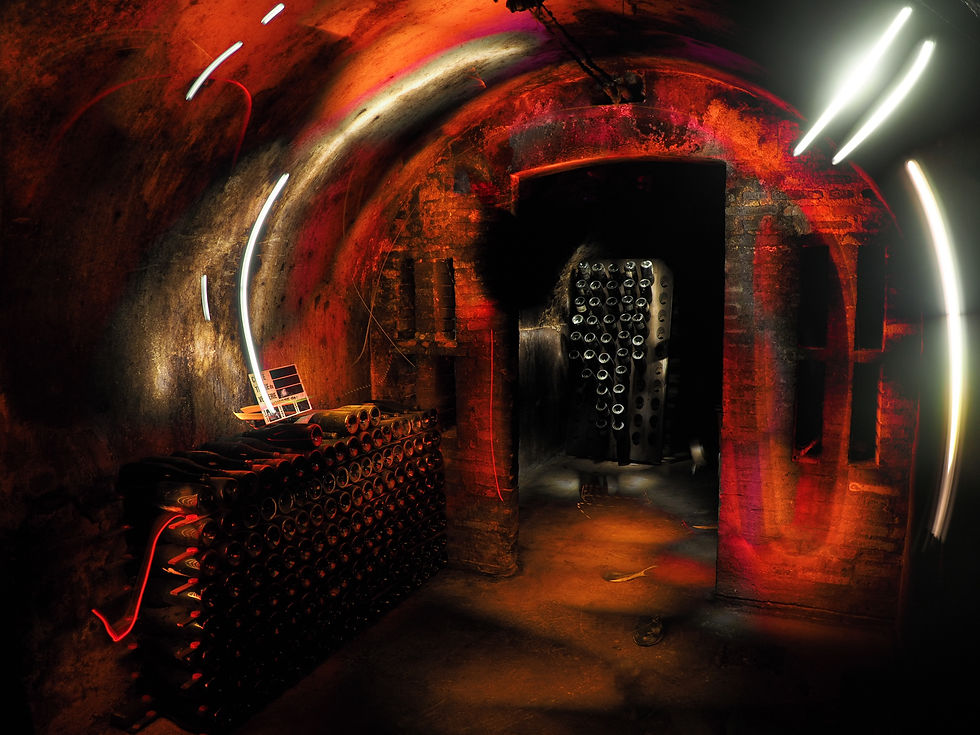
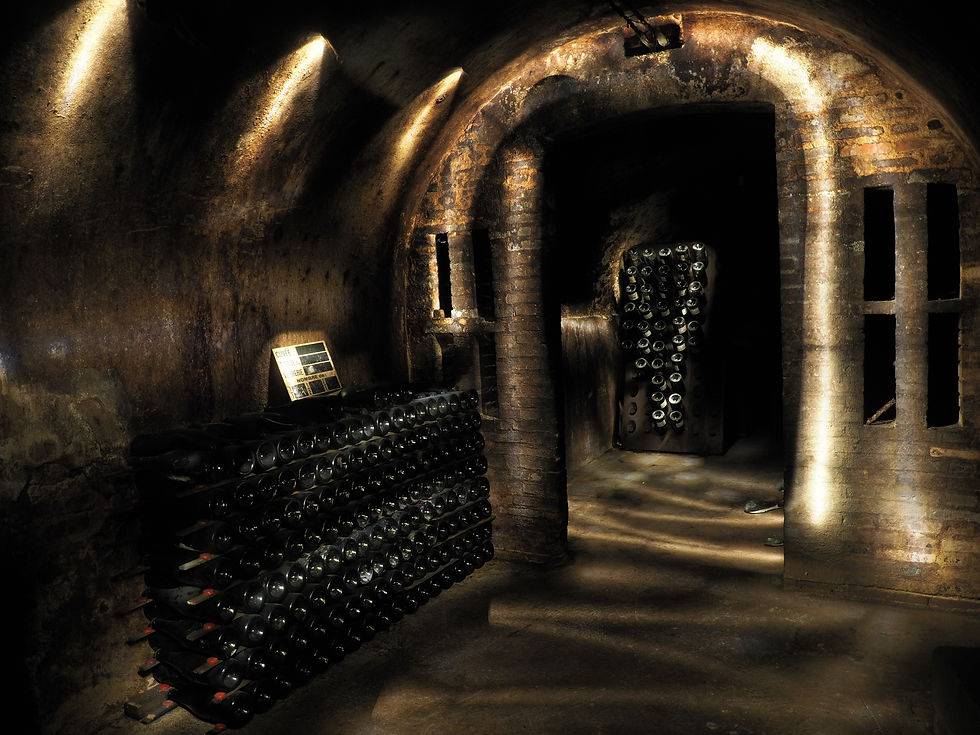
In the estate’s historic vaulted cellars dating from the 17th century, the Champagnes are given at least three years on their lees before release and five for the vintages. It is a patient approach, rooted in the belief that time is not simply part of the process, it is one of the ingredients.
But statistics only tell part of the story.
After giving me a tour of the domaine and its historic cellars, Étienne and I climbed into his little van and headed out into the vineyards.
Rather than simply pointing out the vineyards from a distance, Étienne drove me through them, stopping to show me the different parcels and explain the landscape, the vines and the places that have shaped the Goutorbe style.
That made a difference.

There is something about standing in the vineyard with someone who knows every parcel intimately that changes the way you taste the wine afterwards. A name on a label becomes a physical place. A village becomes a slope. A grape variety becomes something rooted in a particular piece of land.
And then came one of the most unexpected moments of the afternoon.
I had the opportunity to taste Voltis, the disease-resistant variety currently being experimented with in Champagne.
Voltis was approved for experimental use within the Champagne appellation framework in 2022, with the first plantings beginning in 2023 under the VIFA (Variété d’Intérêt à Fin d’Adaptation) programme. The variety is resistant to powdery mildew and tolerant of downy mildew, making it particularly interesting as Champagne considers how its vineyards might adapt to a changing climate.
Étienne also told me about the ongoing reflection around other varieties currently being considered by the Comité Champagne, such as Orellis and Serelis.
For me, this was one of the most interesting parts of the visit. Champagne is deeply rooted in tradition, but that doesn’t mean the region stands still. The work around new grape varieties reflects a willingness to test, adapt and consider what might make sense for Champagne in the years ahead.
Pressing is central to the Goutorbe story. And after spending time in the vineyards with Étienne, it was interesting to see where that journey begins to take another form.

At the Goutorbe pressoirs, grapes are harvested manually, with the selection guided not simply by the vines themselves, but by the specific characteristics of each parcel. The pressing is deliberately slow, and the vinification is adapted to the personality of the individual plots. From there, the musts move into stainless-steel vats for vinification.
It may sound like a straightforward production step, but it is much more than that. The pressoir is one of the first places where the identity of a particular parcel begins to be translated into wine. What I had just seen as vines, slopes and individual plots was now becoming juice, and eventually, Champagne.
But calling it simply a “pressing house” would miss much of what makes the place interesting. It is another piece of the Goutorbe ecosystem in Aÿ, where vineyards, pressing, cellars, culture, family history and hospitality all exist within a remarkably small geographic footprint.
There is even a very modern layer to this otherwise deeply traditional setting. In 2016, Goutorbe installed 26 solar photovoltaic panels above the pressing facilities, along with five hybrid solar panels on the main house, as part of its move toward renewable energy. It is a small but telling detail: a family deeply rooted in tradition, but not afraid to experiment, adapt and rethink how the estate operates.
And, in true Goutorbe fashion, the pressoir has another life beyond the harvest. The building has been used as a cultural space for music and art, including a cello concert held inside the Pressoir Goutorbe, where the music played against the backdrop of its stained-glass windows.
Grapes, solar panels, stained glass and a cello may not be the ingredients one normally associates with a pressing facility. But by this point in my afternoon, I was beginning to understand that at Goutorbe, almost everything seems to come with another layer.
From there, we stopped at 1 Rue du Petit Théâtre, not simply another address for Champagne H. Goutorbe, but a historic Goutorbe site that Étienne has transformed into a cultural and artistic venue. The building was once owned by Moët & Chandon and served as a press house and cellar. Beginning in 2011, Étienne gradually gave it a new life, hosting painting exhibitions, concerts and theatrical performances.
Even the street carries a piece of Aÿ’s evolving history. Originally called Rue des Jardins, it was renamed Rue du Petit Théâtre when the new commune of Aÿ-Champagne was created through the merger of Aÿ, Mareuil-sur-Aÿ and Bisseuil. Bisseuil retained its Rue des Jardins.
It is quite literally a place where Champagne and culture intersect, with a history rooted in viticulture but a present that embraces painting, music and performance. In 2025, it hosted a medieval-music concert as part of Aÿ’s Mai Musical, and in 2026, it was the setting for Jacki Colson’s 80th-anniversary retrospective.
The conversation naturally turned back to Champagne and to Club Trésors de Champagne, of which H. Goutorbe is a member.

Founded in 1971, the association brought together grower-producers around a shared commitment to quality, with the Special Club cuvée becoming its defining expression. H. Goutorbe has been part of that history for decades; René Goutorbe has previously spoken about the importance of the club in helping the family develop international recognition and relationships with importers.
Back at the house, Étienne took me into a special tasting salon. And then the visit took another unexpected turn.
There was a piano.
Étienne sat down and began explaining Champagne through music, using the language of solfège to associate different notes with grape varieties and show how particular chords could evoke the relationship between the components of a vintage. It sounds abstract when put into words. At the piano, however, it suddenly made perfect sense.
He translated the idea of Champagne into something I could hear: the different grape varieties as individual voices, each with its own character, and the blend as a composition in which those voices have to find balance. A vintage, like a piece of music, is not simply a collection of individual notes. It is about how those notes interact and come together to create a melody.
Watching Étienne illustrate the concept at the piano was one of those rare moments when an analogy stopped being an analogy and became tangible.
For someone who spends so much time tasting Champagne analytically, thinking about structure, acidity, fruit, texture, dosage and terroir, it was a wonderfully different and refreshing way of thinking about what is actually happening in the glass. And perhaps it resonated with me even more because I also play keyboard; I instinctively understood the idea of individual notes coming together to create something greater than the sum of their parts.
And the afternoon still wasn’t over.

We walked down the street to Hotel Castel Jeanson, the family’s hotel, a 19th-century mansion created by Nicole and René Goutorbe in 2004. An invitation into the heart of Champagne, within the former home of some of the region’s great dynasties.
Today, the property is known for its architecture and particularly its beautiful stained-glass windows.
But there are stories here that are less immediately visible.
The painter Albert Enocq, born in Aÿ in 1908, died in 2001 at the age of 92. In the 1960s, when the building, now known as Castel Jeanson, was owned by Besserat de Bellefon, he created a series of murals there.
When René and Nicole Goutorbe acquired the building, which was in ruins, in 1999, they initially uncovered paintings bearing the Hamm logo from the 1980s. As the paintings were flaking, a painter from the École des Beaux-Arts was brought in to restore them. During the restoration, the Besserat de Bellefon logo was discovered beneath the later layers, revealing another chapter in the building’s history.
The paintings themselves tell the story of the various trades and professions associated with Champagne.
That same attention to Champagne’s heritage can be seen in the stone markers in the courtyard, donated by the house in connection with the Goutorbe nurseries. The first Champagne marker bears the initials L.O.R., referring to Louis Lérÿ-Roederer. The company Thévenin, based in Cuchery, renovated the glass roof.

The stained-glass windows of Castel Jeanson were restored by Marie-Claire Thierry, from Châlons-en-Champagne and founder of Déco Vitrail Champagne. Another of her creations, dating from 2014, can be seen at the Goutorbe press house on the same Rue Jeanson.
The hotel also contains a 1907 stained-glass window by Vermonet, the Reims-born artist Albert-Louis Vermonet. He married Alone Louise Pommery and signed some of his works Vermonet-Pommery. He was awarded the Palmes d’Officier d’Académie in 1904 and created the stained-glass window in 1907. It can still be seen today in the salon, on the side leading toward the courtyard.
By that point, I realized that I hadn’t simply visited a Champagne house. I had been invited into a family universe. What stayed with me most about my afternoon at H. Goutorbe was not one particular wine or one particular technical detail. It was the generosity of the visit.
Étienne didn’t simply tell me about Goutorbe. He showed me Goutorbe: the vineyards, the cellar, the experimental work, the organizations that matter to the house, the music, the family history and even the architecture that surrounds it. I spent the entire afternoon immersed in that world, moving from vineyard to cellar, from Champagne to music, from past to future.
And perhaps that is what makes a great visit to a Champagne producer so meaningful. You arrive to taste the wine, but if you’re lucky, you leave understanding a little more about the people, the place and the thinking behind it.
My afternoon with Étienne Goutorbe was very much that kind of visit. Personal, generous, passionate, and unmistakably Aÿ.

For more information: https://www.champagne-henri-goutorbe.com


Comments