


Meunier, Tu Dors? Not Anymore!Éric Taillet, the Vigneron Who Gave Meunier Its Own Distinctive Voice


If you're interested in growers who have elevated Pinot Meunier from an "underappreciated blending grape" to one of Champagne's greatest terroir varieties, Éric Taillet belongs on that short list. Taillet has spent decades proving that Meunier can produce profound, age-worthy Champagnes.
Éric Taillet is the fourth generation of his family's estate in the western Vallée de la Marne, where the family has cultivated vines since the early 1900s. After taking over the domaine in 1995, he transformed its identity by devoting himself almost entirely to one grape: Meunier. At a time when many growers viewed Meunier primarily as a blending component, Taillet recognized it as the finest interpreter of his terroirs. Long before Meunier became fashionable among collectors and sommeliers, he was championing its ability to produce wines of remarkable depth, precision, and longevity.
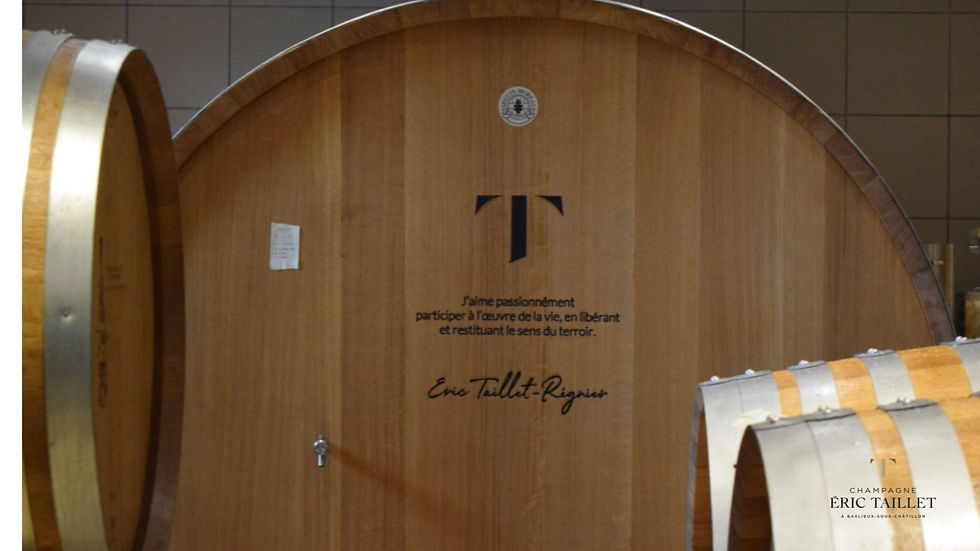
Today, Taillet is widely regarded as one of the leading voices behind Meunier's renaissance. What was once dismissed as Champagne's "third grape" is now increasingly celebrated as a noble variety capable of producing world-class, terroir-driven wines in its own right. That transformation owes much to Taillet's unwavering belief that Meunier deserves the same respect historically afforded to Chardonnay and Pinot Noir.
His philosophy extends well beyond his own vineyards. In 2015, Taillet founded the Meunier Institut, an association dedicated to restoring Pinot Meunier to its rightful place among Champagne's great grape varieties. Bringing together growers, communicators, sommeliers, and passionate advocates, the institute has become an important platform for education, collaboration, and the promotion of Meunier around the world.
Based in Baslieux-sous-Châtillon, Taillet's estate has become one of Champagne's foremost ambassadors for Meunier, with nearly 80 percent of its vineyards planted to the variety. Over the past three decades, he has meticulously refined every aspect of his viticulture, from pruning techniques and canopy management to soil health and biodiversity, to better understand and express Meunier's extraordinary potential. His work has been so influential that cuttings from some of his oldest vines have been selected by Champagne nurseries for propagation.
The impact of Taillet's work can now be seen throughout Champagne. More growers are producing single-varietal and Meunier-dominant Champagnes, while sommeliers and wine lovers increasingly recognize the grape for its transparency, energy, and remarkable capacity to express terroir and age gracefully. Few producers have done more to elevate Meunier's reputation than Éric Taillet.
Taillet's philosophy is rooted in the belief that great Champagne begins in living soils. His vineyards are farmed with deep respect for biodiversity and vine balance, with an emphasis on nurturing healthy ecosystems rather than maximizing yields. In the cellar, the same philosophy prevails, intervention is kept to a minimum so that each parcel can express its identity with clarity and precision. Yet Taillet is also a relentless perfectionist with an insatiable curiosity experimenting with Champagne's lesser-known grape varieties, including Pinot Gris and Petit Meslier. The result is a portfolio of wines by transparency, energy, and an unmistakable sense of place.

As the domaine enters a new chapter, Éric is gradually passing the reins to the fifth generation. His children, Dylan and Léna, are increasingly involved in both the vineyards and the cellar, ensuring that the family's commitment to Pinot Meunier, thoughtful farming, and terroir-driven winemaking will continue well into the future.
Éric is another seminal vigneron I had the privilege of meeting this past April during an Off Le Printemps des Champagnes event. Taillet is one of those iconic names that every serious Champagne lover recognizes but meeting him in person is an entirely different experience. It's a bit like meeting an actor you've long admired, you know the reputation, but then you meet the man behind it, and the encounter proves even more rewarding. He did not disappoint. His passion for his craft, for Meunier, his unwavering commitment to terroir, and his relentless pursuit of excellence were palpable not only in his words but, more importantly, in every tasting he poured.
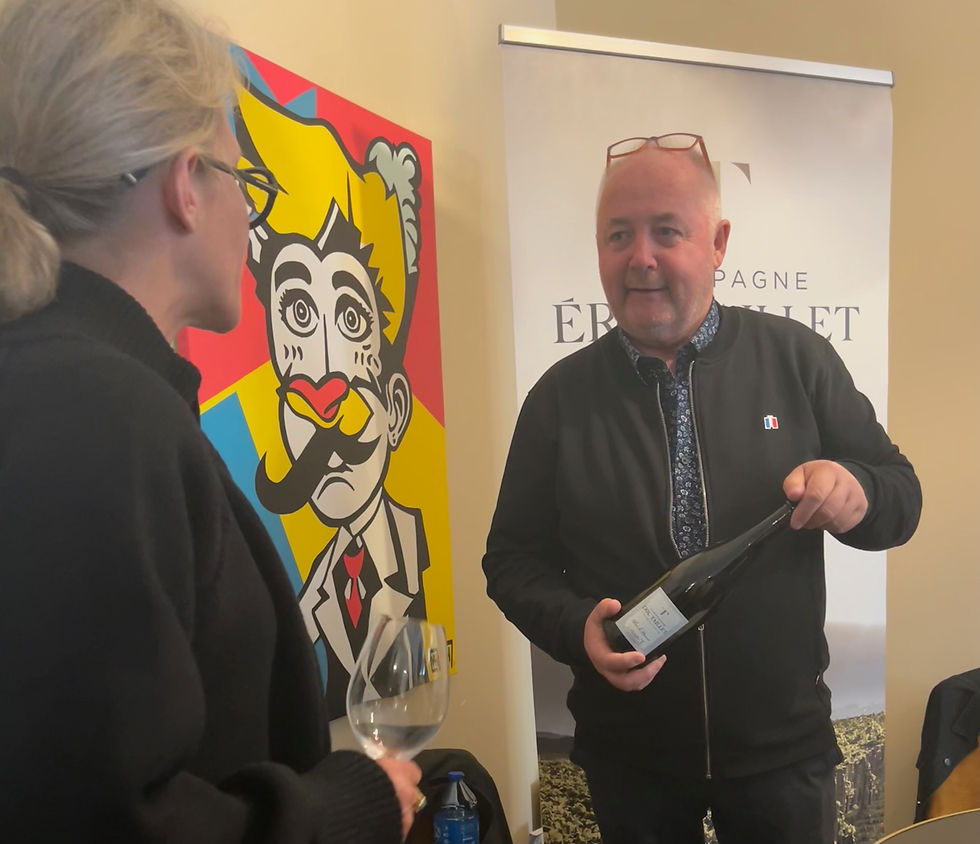
I'm especially grateful that we were able to continue our conversation several months later through this interview. Away from the excitement and bustle of Off Le Printemps des Champagnes, where everyone naturally wanted a few moments of his time, we had the opportunity to explore his philosophy, his work, and his vision for the future of Pinot Meunier in much greater depth.
Your estate is rooted in a family history that dates back to the early twentieth century. How has this legacy, passed down through five generations, shaped your vision of wine?
Above all, I see myself as just one link in a long chain. Each generation has inherited a living legacy made up of vineyards, terroirs, experience, and values. This transmission has taught me humility. We do not create a terroir—we inherit it, and we have a responsibility to pass it on in better condition than we received it.
This family history has also convinced me that wine is not an industrial product, but rather a collective work shaped by nature, time, and human hands. My philosophy is therefore to accompany life rather than constrain it.
Pinot Meunier lies at the heart of your identity. What fascinates you so much about this grape variety, which has long been underestimated in Champagne?

Meunier possesses remarkable honesty and an extraordinary capacity for expression. For many years, it was regarded simply as a blending grape and judged more for its role than for its true potential.
What fascinates me most is its ability to translate the nuances of a place with remarkable precision. Beneath its apparent generosity lies great complexity. Depending on its terroir, it can be gentle or remarkably linear, sun-filled or intensely mineral, broad and generous or finely sculpted. Meunier tells a story that, for far too long, no one was willing to hear. Today, it reveals a depth and identity that fully deserve their place among Champagne's great grape varieties.
You describe Meunier as a "revealer of terroir." In what way does this grape tell the story of the soils of the Vallée de la Marne better than others?
The Vallée de la Marne is an extraordinarily rich geological mosaic. Its vineyards are rooted in clay, marl, limestone, sand, and flint, each producing distinctly different expressions. Meunier acts as an especially sensitive interpreter of this diversity. Whereas some grape varieties tend to impose more of their own varietal personality, Meunier often allows the identity of the soil to speak more freely. Through Meunier, one can perceive the depth of clay, the tension of limestone, and the vibrant energy of flint. It is precisely this ability to convey the voice of the terroir that makes it, in my view, such an exceptional revealer.
You founded the Meunier Institut. What inspired you to create this initiative?
The Meunier Institut was born from a simple conviction: Meunier deserved to be studied, championed, and recognized for its true worth. For many years, the variety suffered from an overly simplistic image. We wanted to create a forum where winegrowers who shared the same passion could exchange ideas, deepen their understanding of the grape, and explore its behavior, terroirs, and many expressions. Our goal was never to pit Meunier against Champagne's other grape varieties, but rather to restore its rightful place and demonstrate that it is capable of producing wines of exceptional origin and character.
Looking back, what impact do you believe this initiative has had, both in Champagne and internationally?
Its first impact was to change the way people perceive Meunier. Many professionals and wine lovers discovered a richness they had never fully appreciated. The Meunier Institut has also encouraged dialogue among producers and helped shine a spotlight on single-vineyard, terroir-driven cuvées. Internationally, it has helped demonstrate that Champagne is far more than the blend of three grape varieties, it is also a region defined by its diverse terroirs and unique identities.
How would you describe the terroirs of your estate, its clay, limestone, marl, and flint, and the influence they have on the style of your Champagnes?
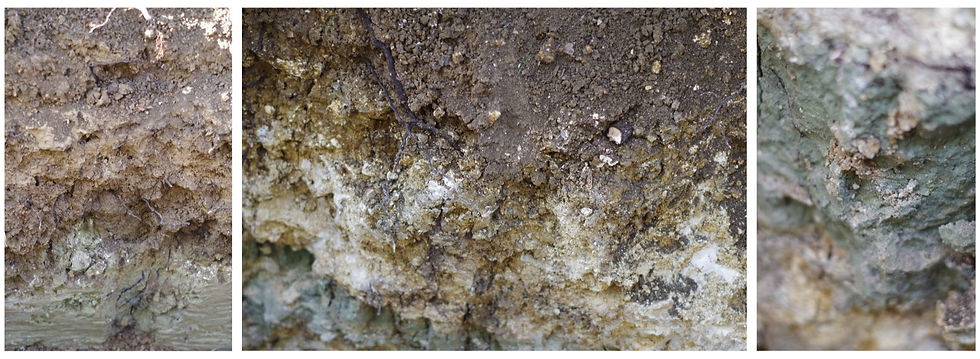
Our estate benefits from remarkable geological diversity.
Clay brings depth, richness, and an important tactile dimension.
Limestone provides tension, freshness, and length.
Marl contributes balance, combining power with finesse.
Flint often brings a more energetic quality, sometimes almost vibrational in character.
Our objective is to allow each terroir to express itself with as little interference as possible, so that every wine tells the story of its origin.
You are part of a generation of winegrowers redefining Champagne's identity. How is this changing the way we understand the region and its wines?
This evolution marks a shift from a philosophy centered on style to one centered on origin. For many years, Champagne was defined primarily by the art of blending. That approach remains fundamental, but a new generation is also seeking to highlight the individuality of each site. Single-parcel vinifications allow us to better understand our terroirs and reveal nuances that were once hidden. Rather than challenging Champagne's identity, they enrich our understanding of it.
Is there a particular stage of the winemaking process that you consider the most decisive in defining the signature of your Champagnes?
The quality of a wine is determined first and foremost in the vineyard. In the cellar, the most important task is probably to preserve what has already been achieved in the vines. Fermentation should accompany the grapes, not homogenize them. The ideal vinification is one that allows the terroir to remain legible. More than creating a style, the goal is to reveal an identity.
Among your cuvées, which one best embodies your identity and your vision of Champagne, and why?
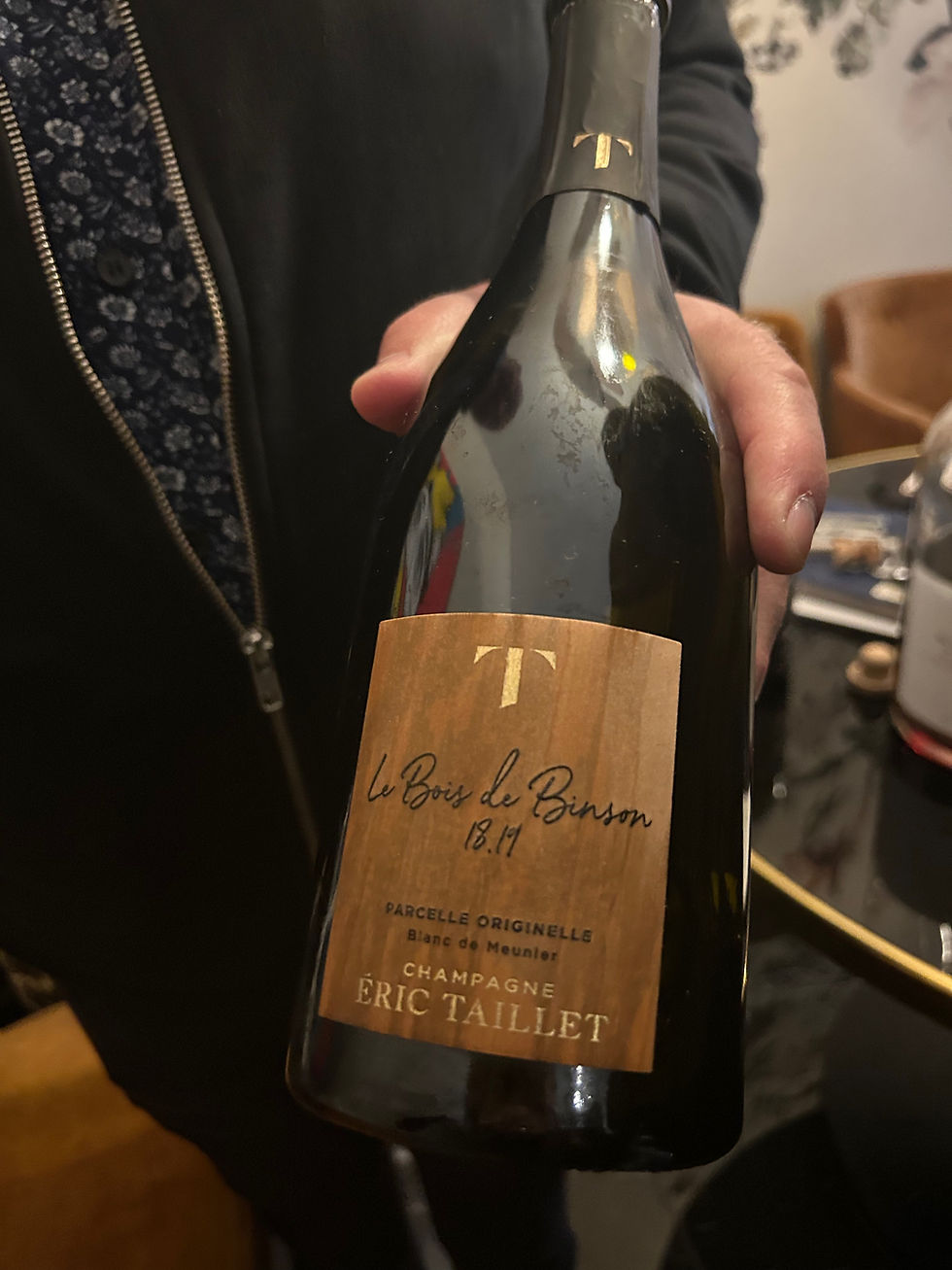
The cuvées Le Bois de Binson and Bansionensi probably express my vision most clearly. Produced from very old Meunier vines and the result of meticulous single-parcel viticulture, they demonstrate that a great Champagne can be born from the purest expression of a single place. They embody my deepest conviction: when a terroir is respected, Meunier is capable of achieving an extraordinary level of complexity and emotion.
When someone tastes your Champagnes for the first time, what would you like them to feel or immediately understand?

Above all, I would like them to experience a sense of authenticity. I want them to understand that this wine does not seek to seduce artificially, but rather to tell a story, the story of a place, a family, a grape variety, and a vintage. If an emotion is born from that encounter, then the wine has fulfilled its purpose.
How is climate change influencing your work today, and what adaptations do you believe are essential for the future of Champagne?
Climate change is profoundly transforming our profession. The growing cycles begin earlier, weather events are becoming more extreme, and the balance of the grapes is evolving. In response, it is essential to strengthen soil vitality, preserve biodiversity, and promote more resilient viticultural systems. Meunier also possesses certain adaptive qualities that help explain its historical importance in the Vallée de la Marne. The future of Champagne will depend on a deeper understanding of living ecosystems rather than an increasing reliance on technical corrections.
What would you like people to understand about your House through a single glass of your Champagne?

I would like them to understand that our work is about liberating the expression of the terroir.
As I often say: "I am deeply passionate about contributing to the work of life by liberating and restoring the true meaning of terroir."
That sentence perfectly summarizes our philosophy: to listen, to accompany, and to pass it on.
Today, your son Dylan and your daughter Lena have joined the family adventure. How are you preparing this transition, and what do you hope to pass on to them beyond technical know-how?
Passing something on is not simply about teaching techniques. Above all, it is about transmitting a way of seeing the world. I hope to instill in them a respect for living things, curiosity, independent thinking, and a strong sense of responsibility. Every generation must bring its own vision. My role is not to ask them to reproduce the past, but to give them the means to build the future while remaining faithful to the fundamental values of the estate.
Is there a question you wish I had asked you?
Yes: "What is, ultimately, the true role of the winegrower?"
Because this question goes far beyond wine itself.
To me, the role of the winegrower is not to manufacture a product, but to interpret a landscape. Our responsibility is to create the conditions that allow the terroir to express itself as freely as possible. Wine then becomes a cultural, agricultural, and human testimony. That is probably the guiding principle behind everything I do: to make Meunier not only one of Champagne's great grape varieties, but also a faithful messenger of the Vallée de la Marne.

For more information got to: https://www.champagne-eric-taillet.fr


Comments