


Frédérique Poret-Duménil: The Current Chapter of a Women-Shaped Champagne Story

An Immersive Visit of Champagne Duménil, in Conversation with Frédérique Poret-Duménil
Just a few minutes outside Reims, the landscape begins to soften as the road slips into Sacy, a small, charming village along the Champagne tourist route in the heart of the Montagne de Reims Regional Natural Park. Classified as Premier Cru, Sacy feels tucked away despite its proximity to the city, quiet, intimate, and deeply rooted in history.
The village’s name is thought to derive from the Latin Sakis, meaning “healing water,” an origin that suits a place long shaped by natural springs. At its center stands a monumental washhouse, a reminder of when water structured daily life here. Sacy was once a site of pilgrimage, its fountain believed to cure headaches and drawing visitors in search of its reputed healing properties. It’s no surprise the village had running water as early as 1900, fed by these abundant sources. Today, it is no longer water but Champagne that flows through its identity, sustaining the quiet prosperity of this picturesque corner of the Montagne de Reims.
Overlooking the village, the Château de Sacy lends a note of understated elegance, while the Romanesque tower of the Saint-Rémi church watches over the rooftops. Inside, it preserves depictions of Saint Anne, the Virgin, and Child, quiet anchors of faith and continuity woven into the village’s long history.
At the entrance to Sacy, Champagne Duménil sits almost inconspicuously in place, until one detail gives it away: a Renault Juvaquatre (produced by Renault from 1937 until 1960) repurposed as a charming piece of signage for the est
ate. A great example of the small, agile utility vehicles that were essential for local French businesses and vineyards during that era, it now stands as a nostalgic emblem, its burgundy rims echoing the house’s unmistakable signature color. Even before stepping inside, there’s a sense that this won’t be a formal, polished visit, but something warmer, more personal.
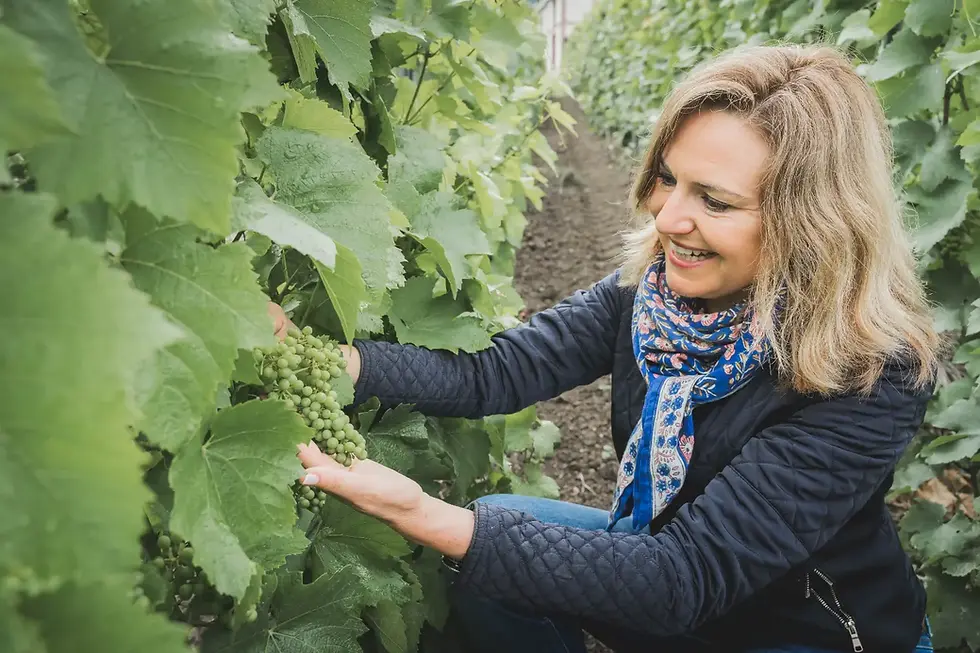
That impression holds from the moment I meet Frédérique Poret-Duménil. There’s no rehearsed introduction, no distance, just a warm and welcoming presence and an openness to tell her story.

It starts, as many Champagne stories do, with family. But at Champagne Duménil, the narrative is less about legacy as a given and more about legacy as something continually rebuilt, sometimes abruptly, sometimes courageously, always deliberately. she situates herself plainly within that lineage: “I am the fifth generation. I took over in 2000.”
Her path here was anything but predetermined. With a background in law, she hadn’t grown up with a clear plan to take over the estate. “I didn’t really know what to do. I had been told that studying law could lead to anything,” she admits with a smile.
Still, she was certain of one thing:
“Independence was fundamental to me, a synthesis of freedom and creativity. I knew I wanted a profession with an entrepreneurial dimension, something without monotony.”
It was only after meeting her husband that her perspective began to shift. Through him, she discovered a different vision of winemaking, one that was both innovative and deeply rooted in terroir. “He showed me another side of the profession, both modern and anchored in the land.”

She eventually returned to the family estate, spending five years learning alongside her father, absorbing the rhythms of both vineyard and cellar.
“Like my sisters, I was never under any pressure to take over the estate,” she explains. “But there was a guiding principle: it is essential to find fulfillment in your work, do what you want, but work hard, choose a field you are passionate about, and above all, put your heart into it. I grew up surrounded by wine and food. My father, a refined winemaker, passed on to me this deep appreciation for wine and helped shape my sensitivity. Passion ran through his veins.”
But just as that apprenticeship was beginning to take shape, everything shifted.
“My father passed away suddenly on May 8, 2005,” she says. Then, almost in the same breath: “And then my daughter was born on June 12, 2005.”
Loss and new life collided within weeks. The contrast is striking, and she doesn’t try to soften it. At 25, with only a few years of experience behind her, she found herself suddenly at the head of the estate.
“Five years, in the life of a vineyard, is very little,” she says.
What could have been overwhelming instead became a moment of clarity. Her husband stepped in without hesitation. “I found myself alone at the press and he took over all the vineyard work.”

By the following year, the decision felt obvious. “We said to ourselves, ‘We need to build something together.’” She recounts it without drama, just acceptance of how life unfolded and how the domaine came to be.
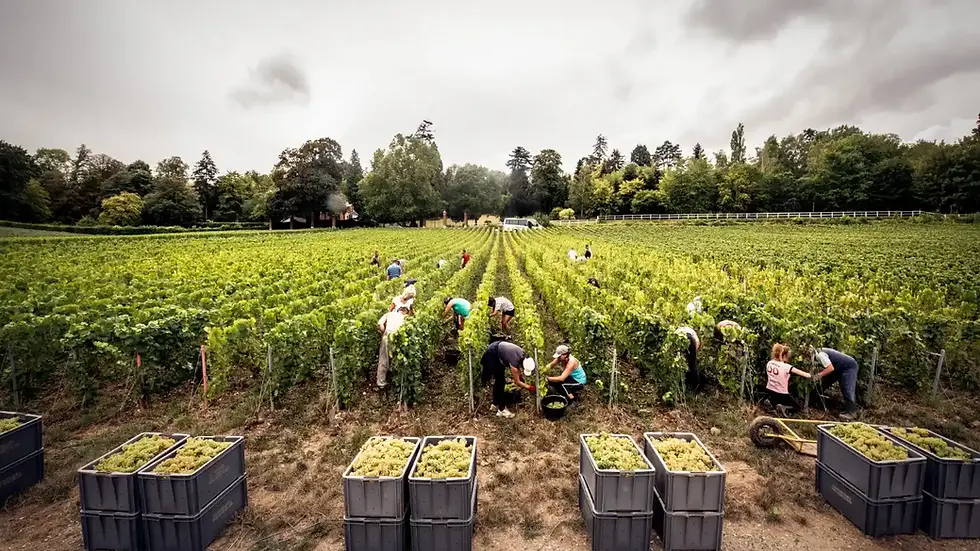
While Sacy is her adopted village and the home of her husband’s vineyards, Champagne Dumenil is rooted in three distinct terroirs: Chigny-les-Roses, Ludes, and Rilly-la-Montagne. The estate’s parcels unfold across these villages on north-facing slopes that naturally preserve freshness, while the surrounding forest acts as a protective barrier. This setting creates a privileged microclimate, where woodland shelter and the Montagne de Reims work in tandem as a natural shield. Beneath the vines, layers of chalk, clay, and limestone, fed by mineral-rich springs, bring the wines their signature structure, tension, and precision.

“Our terroir is known for the elegance of its fruit. The Meuniers are classified as Premier Cru, recognized for their finesse and aging potential. The uniqueness of the soil and subsoil lies in five distinct layers, which force the roots to grow deep in search of water. The minerals carried by the natural springs impart a singular character to these wines of the Montagne,” she explains. “Our estate is highly fragmented, with 45 parcels spread across 29 lieux-dits. This diversity of exposures and microclimates gives rise to wines with real character.”
If her father passed on the technical foundations, it is her grandmother who continues to shape her way of thinking. Frédérique speaks of her with deep admiration, returning to her not as a distant figure, but as a living presence that still informs the way she works.
“My grandmother was very discreet, but she knew where she was going,” she says with fondness in her voice.

It was this grandmother who made one of the most defining decisions in the estate’s history: planting chardonnay in Chigny les Roses, a part of the Montagne de Reims where it was far from obvious. “My grandmother began planting Chardonnay in Chigny-les-Roses as early as 1969 to create her exceptional vintage wines. That same boldness is reflected today in the freshness of our reserve wine collection. Such a daring vision required a deep and precise understanding of the terroir,” says Frédérique.
The goal was not stylistic experimentation, but structure and longevity. “Her goal was to increase the aging potential. Acidity is the backbone of the wine,” she explains, echoing a philosophy that still underpins the house style. That choice lives on in cuvées like “Histoire de Chardonnay”, their Blanc de Blancs, which she describes as approachable yet distinctive.
That idea still defines the wines today. There’s a generosity to the chardonnays here, something softer, more inviting. “We have more generous Chardonnays, very seductive,” she says. “A true gateway into this grape variety.”

Walking through the cellar, it becomes clear that time is not just a factor here, it is the defining element. Bottles rest quietly, sometimes for years beyond what is required.
“We have a volume of stock that represents several years. It is a treasure passed down from generation to generation,” she tells me.
In a world increasingly driven by speed, she sees Champagne differently. “Today, everything moves very fast, but when you plant a vineyard, it takes almost fifteen years before you can bring the wine to market.”
That patience extends into every decision. The house maintains a perpetual reserve begun by her father in 1996, a living blend that carries forward the memory of past vintages. “The key word for us is balance,” she says. Not power, not austerity, but harmony between years, between grape varieties, between structure and generosity.

It is a philosophy that places her slightly apart from some contemporary trends.
“I feel entrusted with a mission: to craft Champagnes capable of aging over time, just as my grandmother dreamed. Given climate change, striving to create great vintages is an exciting but risky challenge. Today, everything moves at the speed of light, I feel somewhat at odds with current trends, as I believe time is an ally.”
While parts of the Champagne world lean toward extremes, zero dosage, single plots, radical minimalism, Frédérique remains committed to blending. She speaks about blending not as a technique, but as a form of expression. “I truly believe in the complementarity of terroirs, parcels, and vintages.” Says Frédérique.
In a Champagne landscape increasingly drawn to extremes, her approach feels grounded, almost reassuring. Even the question of dosage, often debated, is handled with pragmatism. “I have no taboos, what matters is harmony.”

Instead of using neutral sugar solutions, Frédérique crafts her own liqueurs from reserve wines, ensuring continuity in flavor. The goal is to create a seamless whole where nothing feels added or artificial.
“It’s a historical liqueur recipe made from our own wines. Rather than masking the wine, the liqueur enhances and preserves it. Like members of a family, the wine and the liqueur come from the same lineage, they recognize each other instantly,” she quips. “It’s a winning duo; they elevate one another. There is no dominance or competition. It is an ancestral savoir-faire.”
At the same time, tradition does not mean resistance to change. Early in her career, Frédérique made a bold investment in a new type of press, chosen for its reliability and spirit of innovation.

“From the moment I took over, we invested in innovation, including a PAI press with an inclined plate, cutting-edge technology in pressing. The goal is to extract pure fruit while avoiding tannins from the Pinot grapes (patented in 2001), “she explains. “In 2023, we acquired a variable-capacity PAI press, the only type that truly guarantees freshness by adapting to the volume harvested, ‘picked and pressed immediately. I thought it was the Porsche of the press,” she adds with a hint of amusement.
This balance between innovation and respect for raw material defines much of her approach. In the vineyards, the same mindset applies. The estate has avoided insecticides since 1999 and now holds environmental certifications, but she is quick to point out that there is no universal formula. “There are no general rules. Each parcel reacts differently. It’s a constant process of learning, adjusting, and sometimes accepting that nature will decide.”

As we left the cellar, I ask about the future, about the next generation and whether her daughters would carry the torch. She pauses briefly before answering. “We don’t put pressure on them. My elder daughter, Victoire is very interested in the vineyard and wine. However, she still needs to build broader professional experience. She has just returned from Adelaide, Australia, and will be heading to Oregon in three weeks to explore work around Pinot Noir. We’ll revisit the question in ten years.”
Then, with a slight smile she adds: “But it’s part of our roots.”
What stands out most throughout the conversation is how present she is in every part of the domaine. She speaks about the vines, the cellar, the wines, but also about the people. The team, the partners, the customers.
“We need people who understand wine, our wines,” she says.

Despite the growing global demand for Champagne, Duménil remains deliberately small. About half of production stays in France, with the rest exported through carefully chosen partners. With limited volumes, for her, distribution is not about scale but about alignment, finding people who can tell the story behind each bottle.
When I ask what defines the identity of the house, Frédérique returns to her roots: “My father was an epicurean, passionate about gastronomy and deeply generous. He crafted wines of generosity, meant to be shared with those close to him. Today, our reserve wines define the singularity of the estate, marked by a perfect balance between freshness and maturity. These reserve wines are the family’s jewels.”
But she is quick to point to another defining pillar: “The spirit of the house is also embodied in the Special Club, an approach that strives for excellence with humility, grounded in constant self-reflection. It is a Champagne of character, expressing the typicity of the vintage, the terroir, and the winemaker’s savoir-faire,” she adds with pride.
By the time we return to the tasting room, the conversation has settled into something even more relaxed. Glasses are poured, and the wines begin to speak for themselves. There’s a natural continuity between what she’s described and what’s in the glass, the balance, the texture, the sense of time.

Curious, I ask her what she hopes people feel when tasting her wines.
“I hope they truly enjoy themselves, that they look down and suddenly realize the bottle is already empty. That sparkle in their eyes, the pleasure of sharing, a sense of fullness and well-being… seeing them smile. A smile is contagious, and the eyes never lie,” she says.
It feels like a fitting end to an encounter that never once resembled a formal interview. What remains with me is the sense of having been welcomed into something real, something built over generations. Here, inheritance is not simply received. It is interpreted, adapted, and above all carried forward, one decision, one vintage, one generation at a time.
Before the conversation ends, she adds something almost unprompted, a reflection that feels like the missing piece of everything she has just shared:

“What have I learned in 27 years in this profession? Life has taught me that you can’t plan everything, that you must adapt and look toward the light, even when the year is dark.
I thought I had everything mapped out:
2000–2005, training at the estate.
2005, a baby in the summer, a perfect time, especially while my father was still able to work. January 2005, my father is diagnosed with cancer.
May 8, 2005, my father passes away.
One volcano goes out, another life awakens. Victoire grew up between a vat and a vine. Life can be harsh and unfair, but it also holds beautiful surprises, and above all, there is always a way forward. When you work with nature, you must be humble, know how to listen, and be patient.”
At Champagne Duménil, the wines are not merely the result of terroir or technique. They are, unmistakably, the reflection and signature of a woman, her story, her craft, her passion, and her dedication at every stage of the process, guided by a simple conviction: balance is built over time, not against it.
Learn more at www.champagne-dumenil.com


Comments