


Inside The World Of Arnaud Gounel-Lassalle: The Winemaker Reinventing Chigny-les-Roses

How an independent grower-producer is trading traditional luxury codes and radically rethinking Champagne as a serious, parcel-driven wine for the table.

In the Premier Cru village of Chigny-les-Roses, hidden within the folds of the Montagne de Reims, Arnaud Gounel-Lassalle is crafting Champagnes that challenge many of the assumptions people still hold about the region. His wines are not so much built around luxury codes or the polished consistency associated with the Grandes Maisons. Instead, they belong to a growing movement that sees Champagne first and foremost as a wine of place, something capable of expressing geology, texture, seasonality, and memory with the same nuance as Burgundy.

For Arnaud, that philosophy is inseparable from family history. “My great-grandparents were born around 1880,” he explains. “They came from Ludes, the neighboring village. They worked at Champagne Canard-Duchêne in the vineyards, the press house, and the cellars. They purchased their first vineyard parcels with the money they earned from their salaries there. At that time, people married nearby. They traveled either by foot or by horse.”
The roots of Champagne Gounel-Lassalle run deep in the local history of the region. For generations, the family cultivated vines while working within the cooperative system. Arnaud’s father, representing the third generation, retired in 2002 and had been a cooperative grower since 1954, delivering his grapes to the Chigny-les-Roses cooperative.
From the age of fourteen, he contributed to the collective effort, dedicating himself fully to the work while also learning how to pass down knowledge and develop direct relationships with private clients. He traveled throughout France in his truck selling the family’s Champagnes, welcomed visitors to the estate, and constantly worked to grow the business with the goal of transmitting it to future generations.
Each year, the family sold between 30,000 and 35,000 bottles, which they labeled by hand after long days spent in the vineyards, the rhythm of a winegrower deeply rooted in a spirit of collective endeavor.
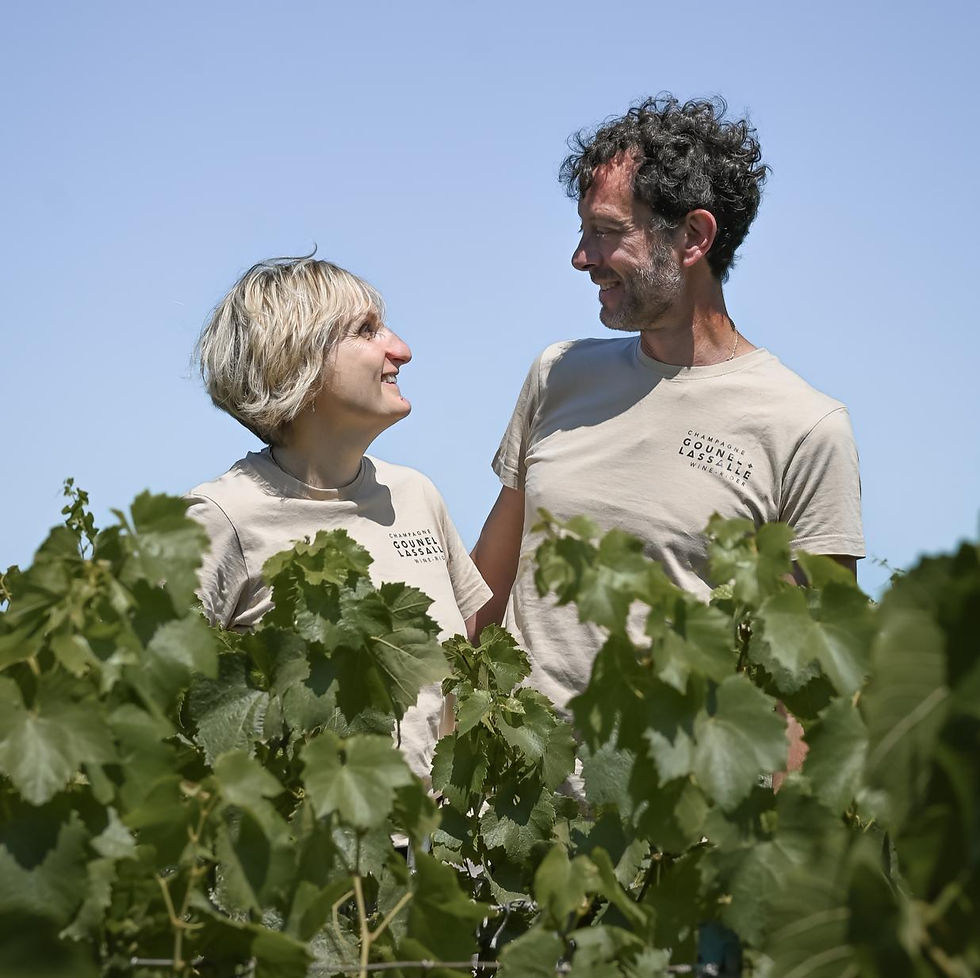
The turning point came in 2016, when Arnaud’s wife Sophie joined the project. A Parisian by origin, she arrived at a moment when Arnaud had begun imagining a different future for the family vineyards. “We wanted to spread our wings,” he says. “To highlight our terroir, my desire to vinify on my own.” Together, they left the cooperative in 2017 and began building Champagne Gounel-Lassalle as an independent grower-producer focused entirely on parcel-driven wines and low-intervention winemaking.
Today, the estate farms five hectares, with 3.20 hectares centered around Chigny-les-Roses and neighboring Ludes, and another 1.8 hectares in the Vallée de la Marne, roughly fifty kilometers away. For now, the Vallée de la Marne fruit is sold to maintain cash flow, while the domaine’s identity remains firmly rooted in the chalk-rich slopes of the Montagne de Reims.
“We worked with a branding agency and really created everything from scratch around my ideas for the wines,” Arnaud explains. Those ideas revolved around one basic ideology: revealing the individuality of each parcel rather than blending vineyards into a single homogeneous house style.
Chigny-les-Roses itself plays a crucial role in shaping the wines. Unlike the famous Grand Cru villages that dominate Champagne prestigious reputation, it remains relatively discreet, but Arnaud speaks about it with almost geological precision. “It’s small, complex, and not very well known,” he says. “But we stand with both feet in chalk.” The village sits within a kind of concave basin formed by erosion over centuries, creating a patchwork of soils that range from wet chalk and dry chalk to clay and silty limestone. “We have many different soils,” he explains. “That allows us to make truly different wines.”

Yet despite this diversity, he believes there is always a common thread running through the wines. “There is always the same thread, tension, salinity, chalk.” That mineral backbone gives his Champagnes a remarkable sense of structure and gastronomic precision. They are wines that seem designed less for aperitif culture than for the table, capable of moving through sauces, textures, and layered dishes without losing their freshness or identity. “Champagne is a wine that goes very well with gastronomy,” Arnaud says. “Not just for celebration or aperitif.”
That idea of Champagne as serious table wine sits at the heart of the project. It is also one reason the wines have found a devoted audience among sommeliers and Michelin-starred restaurants. “We’re fortunate that many of our wines end up in fine dining,” he notes. In many ways, Gounel-Lassalle reflects the broader evolution of grower Champagne over the last two decades, as younger producers move toward terroir transparency, zero dosage; the Brut Nature and more artisanal methods.
One of the estate’s defining characteristics is its commitment to Meunier, a grape long dismissed as Champagne’s black sheep. Yet in his hands, Meunier becomes something entirely different. Through parcel-by-parcel vinification, he explores how the grape behaves across varying soils and exposures, particularly the distinctions between wet chalk, dry chalk, and clay. “We can have Meuniers growing on wet chalk, dry chalk, or clay,” he explains. “They become three different expressions, three different moments.”
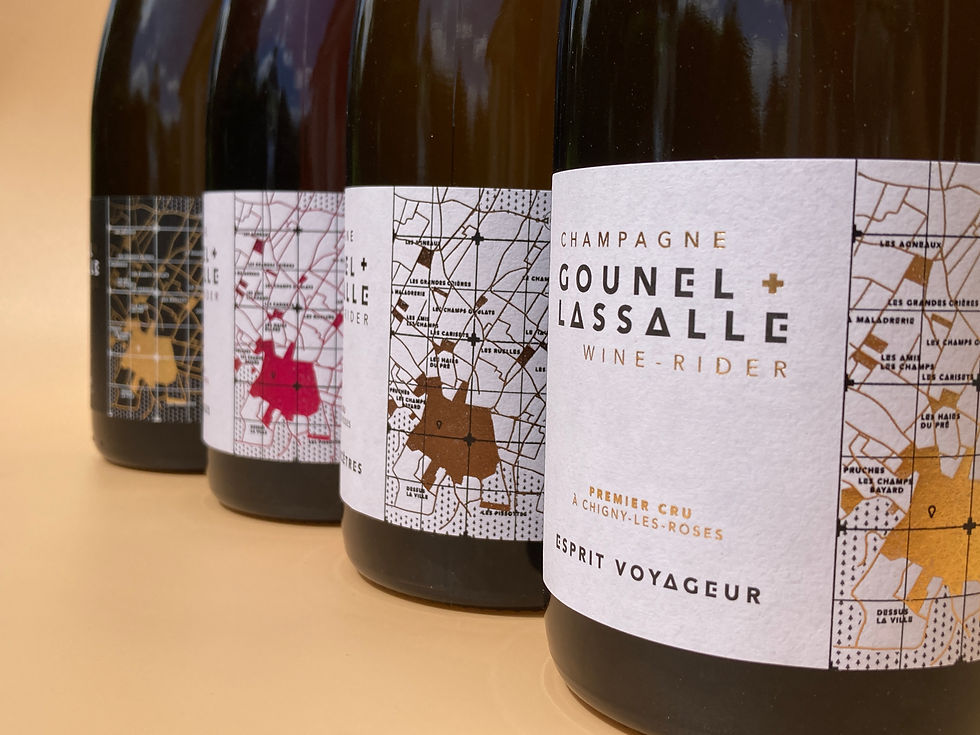
The results often surprise tasters. “People think it’s Chardonnay,” he says with a smile. “What they recognize is not the grape, it’s the chalk.” His work with Meunier has become central to the identity of the house, helping reposition the variety as capable of precision, minerality, and age-worthy complexity rather than simple fruitiness.
The cellar philosophy follows the same logic of restraint and transparency. Arnaud avoids ideological rigidity, preferring practical farming rooted in observation rather than certification. “The goal is not to have a little green logo,” he says. “The goal is to stay close to living things.” The domaine works sustainably, limits sulfur additions, avoids excessive pumping, and relies heavily on gravity during vinification. Oak is used carefully, not as a stylistic statement but as a tool for texture and stability. “The barrel is mainly for micro-oxygenation,” he explains. “Not for strong wood flavors.” The wines are often vinified and aged in neutral barrels with gentle toasts, preserving the purity of the fruit while building depth and texture over time.

That same refusal to impose excessive technique shapes his broader vision of winemaking. “I’m not a magician,” he says. “I try to work with what I have.” Vintage variation, parcel identity, and the realities of climate remain central to the wines. While discussions around sustainability and climate change dominate modern viticulture, Arnaud approaches the subject with a certain humility. “The vine existed long before humans,” he says. “It will adapt. We will have to adapt too.”
Beyond the vineyards and cellar, there is also a sense of movement and openness that defines both Arnaud and the estate itself. He speaks often about travel, languages, and discovering other cultures and techniques. “The most important thing is relationships with people,” he says. “Speaking other languages, discovering other techniques, other cultures.” That curiosity partially explains the estate’s playful “Wine Rider” image, including the electric skateboard he famously uses to move through the vineyard roads around the domaine. “It’s practical,” he laughs. “I’ve been using it for fifteen years.”

The contrast is striking: an estate deeply rooted in ancestral land and tradition, yet shaped by curiosity, travel, and contemporary culture. Even the name Gounel-Lassalle reflects an older family alliance, bringing together the surnames of both sides of the family dating back to the early twentieth century. Heritage, here, is not treated as nostalgia but as something living, something that must evolve without losing its foundations.
That philosophy appears most clearly in the cuvée Terre d’Ancêtres, whose name references the generations that cultivated these soils before him. “We have a responsibility toward what previous generations left us,” Arnaud says. “We don’t think only short term.” It is an idea that extends beyond viticulture into the future of the family itself. His sons are still finding their own paths, traveling and exploring the world before deciding whether they will eventually return to Champagne. “If the next generation wants to continue the adventure,” he says, “we have to leave them the freedom to bring their own stone to the building.”

Today, Champagne Gounel-Lassalle exports roughly three quarters of its production across nearly twenty countries, with growing visibility in North America and Southeast Asia. Yet despite the increasing recognition, the estate retains a sense of intimacy and independence. The wines feel personal, patient, and deeply connected to place.
Ultimately, what Arnaud Gounel-Lassalle is building is not simply a Champagne house, but a philosophy of stewardship, one rooted equally in land, family memory, and the belief that Champagne can still communicate something profoundly human. His wines are thoughtful, deeply personal expressions that speak to the enduring human desire to leave behind something meaningful and lasting. They are wines that remind you that Champagne, at its best, is not merely something to celebrate with. It is something to think about.
For more information visit: https://www.champagne-gounel-lassalle.fr/


Comments